















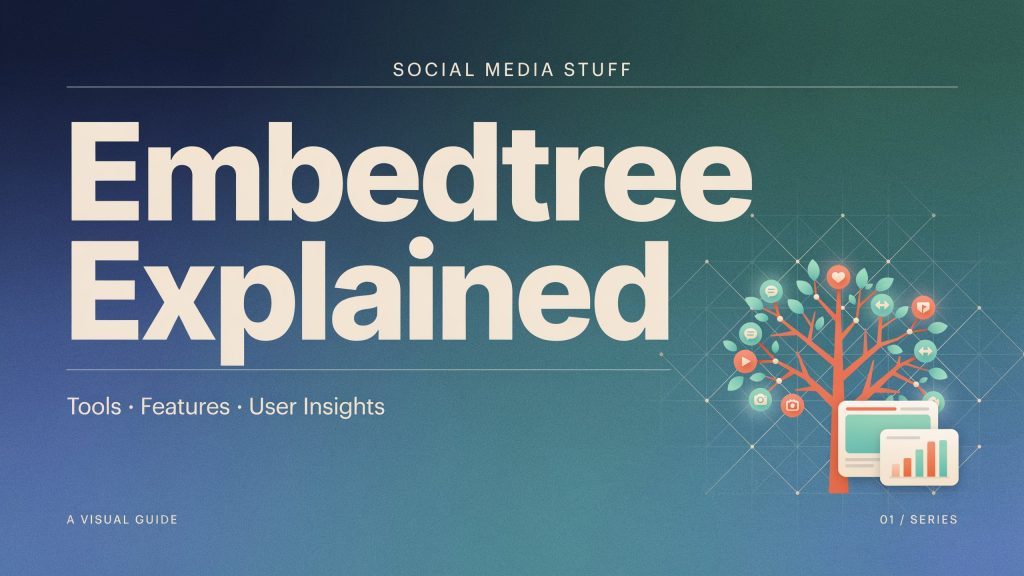
Social Media Stuff on EmbedTree appears to be a content category on a broader site, not a clearly separate software product page. Some EmbedTree pages also describe social feed embedding, customization, analytics, and website integration features.
What Social Media Stuff Means on EmbedTree
EmbedTree’s public site presents itself as a mix of games, software, social media, and tech tips. Its About page says it is a “one-stop destination” for Games and software, Social Media, Tech Tips and tricks, Powerful IT Tools, and Lost Ark. The main navigation also includes a section called “Social Media Stuff.”
That matters because the phrase “Social Media Stuff Embedtree” can point to two different things. It can mean the social media category on the site, or it can mean the product-style claims on some EmbedTree pages that describe a social media embedding tool. The public pages do not present this as a clean, separate software brand with a single product dashboard and support center. They present it more like a content site with product-like articles mixed in.
The category page itself shows that the section is mostly editorial. It includes articles on Instagram growth, private story downloads, social media copywriting, teen safety, collaboration, and creator strategy. That is a strong sign that “Social Media Stuff” works as a topic hub inside the site, not only as a tool page.
Tools and Features Claimed on the Site
One EmbedTree article describes the platform as a social media feed aggregator for websites. In that description, EmbedTree supports feeds from Instagram, Twitter, Facebook, YouTube, TikTok, LinkedIn, and Pinterest. It also says the platform generates responsive embed codes for WordPress, Shopify, Wix, and custom HTML sites.
The same page says users can filter content by hashtags, keywords, mentions, or specific accounts. It also says the platform can keep feeds updated in real time by pulling in new posts and removing deleted content. Those are core features for any social media embed or aggregator tool.
The article also lists layout and design controls. It mentions grid layouts, masonry views, carousels, and list presentations. It says users can change color schemes, fonts, spacing, and animation effects through a visual editor. It also says responsive design helps content display on desktop, tablet, and mobile devices.
Another section says EmbedTree offers moderation tools and analytics. The moderation tools can filter content by specific criteria. The analytics track views, clicks, interaction rates, click-through rates, interaction time, and audience demographics. Those are common features in social media aggregation products because they help teams control what appears on a site and measure what visitors do with it.

How the Platform Is Described to Work
The public description of the workflow is simple. A user creates an account, selects the content type, pastes a URL, and lets the platform generate a code or widget. After that, the user adjusts the look and feel, then saves or publishes the result on a website or blog.
That workflow matches the standard idea of an embed tool. It is meant to reduce manual work, since the user does not need to build every feed or content block by hand. The site says the platform is designed for both beginners and more experienced users, with an interface that is meant to stay simple.
The product-style page also says the tool works for people who want to embed videos, social media posts, and other content into websites. In the text on that page, EmbedTree is described as useful for individuals and businesses that want to improve web presence through embedded content.
User Insights From the Public Pages
The clearest user insight from the public site is that the audience seems broad. The About page talks to technology readers, gamers, social media users, and people interested in digital tools. The category pages then reinforce that mix by covering social media strategy, gaming, and tech tips in the same brand.
Another clear insight is that the site leans heavily on educational and article-based content. The social media section is full of how-to style posts and explainers, which suggests that readers are expected to learn from the site rather than only use it as a software portal. That makes the brand feel closer to a digital content publication with tool-related pages than to a conventional SaaS product site.
A practical reading of the public footprint is that visitors may come for two reasons. Some will want social media guidance, such as Instagram growth or content strategy. Others may be looking for an embed or aggregation tool that can collect social posts and display them on a website. The public pages support both use cases, which is also why the keyword can feel confusing.
There is also a trust signal issue. A secondary analysis of the public footprint notes that the site mixes blog-style content with product-style claims, which can make the brand identity less clear for buyers. That is an inference based on how the pages are presented, not a claim about the company’s internal operations.

What Buyers Should Check First
Before treating EmbedTree as a working social media tool, the safest step is to verify the basics on the live site. That includes clear pricing, product documentation, support options, integration steps, data handling, and a visible dashboard or demo. The public pages I found describe features, but they do not make the product structure as clear as a standard software vendor site usually would.
It is also worth checking whether the content you are reading is editorial or product related. On EmbedTree, “Social Media Stuff” is clearly used as a content section, while other pages use stronger software language. That split means the same brand name can refer to both a topic hub and a claimed embedding solution.
If the goal is website embedding, the most important features to confirm are platform support, feed refresh behavior, moderation controls, and analytics. Those are the areas where a real tool can save time and improve content display. The EmbedTree pages publicly mention all of them, so they are the right place to start when checking fit.
Key Features at a Glance
| Area | What the public pages say | Why it matters |
|---|---|---|
| Social platform support | Instagram, Twitter, Facebook, YouTube, TikTok, LinkedIn, Pinterest | Helps centralize content from many channels. |
| Embedding output | Responsive embed codes and widgets | Lets users place content on websites. |
| Filtering | Hashtags, keywords, mentions, specific accounts | Helps show only relevant content. |
| Design control | Grid, masonry, carousel, list, fonts, colors, spacing | Helps match brand style. |
| Moderation | Content filtering by criteria | Helps reduce unwanted posts. |
| Analytics | Views, clicks, interaction rates, time, demographics | Helps measure engagement. |
| Website integration | WordPress, Shopify, Wix, custom HTML, other CMS mentions | Helps with common publishing setups. |
Common Uses for Social Media Embeds
For a creator, a social media embed can bring several profiles together in one place. That can make a website feel more current, because recent posts can appear without manual copying. The EmbedTree pages describe exactly that kind of central feed experience.
For a business, the value is usually different. A brand may want to show campaign posts, customer content, or a curated feed that keeps the site active. The public feature set on EmbedTree, especially filtering and moderation, fits that kind of use.
For a publisher or blogger, the attraction is often speed. A code-based embed can be easier than building a custom feed system, especially when content comes from multiple social accounts. That is the basic promise repeated across the EmbedTree pages.
Organizations that rely on workforce management platforms such as HMH Smart Square often use embedded social feeds on internal portals and websites to improve communication, employee engagement, and real-time information sharing.
SEO Value of the Topic
The keyword has search value because it mixes two strong intent types. One part is informational, since people want to understand what EmbedTree is. The other part is commercial, since some readers may be comparing social feed tools for a website or brand project. The public pages support both angles, which is why the topic can work well for evergreen search content.
The safest SEO framing is to explain the topic clearly and avoid pretending the public evidence is cleaner than it is. Based on the pages available, Social Media Stuff EmbedTree is best described as a social media content category on the site, plus a set of product-style claims about feed embedding, customization, moderation, analytics, and integration.
Before publishing social media content, many marketers use tools like Zuhio Keyword Count Checker to measure keyword frequency and maintain a natural keyword balance across posts, captions, and website content.


