















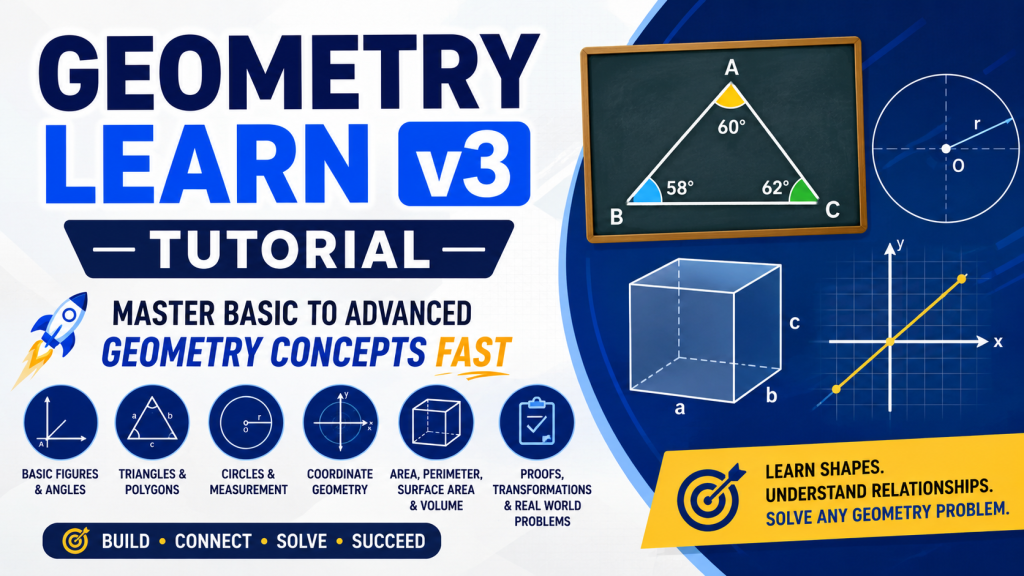
Geometry Learn v3 helps learners move from basic shapes to advanced geometry in a clear and fast way. It works best when you study core terms, practice often, and follow each topic in order.
What Geometry Learn v3 Covers
Geometry Learn v3 is a structured way to study geometry from the ground up. It usually includes lines, angles, triangles, circles, polygons, coordinate geometry, area, perimeter, surface area, and volume. It also helps with proofs, transformations, and real world shape problems.
A good geometry program works in steps. First, it teaches basic figures and their parts. Then it moves to measurement, relationships, and formulas. After that, it covers higher level topics such as similarity, congruence, and geometric reasoning.
The goal is simple. You learn how shapes are built, how they connect, and how to solve problems using rules that stay the same in every grade and exam.
If you want to explore related online tools and platforms, you can also check the Dasberflo Review to understand how different digital learning or web tools are evaluated for accuracy and usability.
Basic Geometry Concepts
The first step is learning the language of geometry. Without this, later topics become confusing.
A point shows a position. It has no size. A line goes on forever in both directions. A line segment has two endpoints. A ray starts at one point and goes in one direction. An angle is formed when two rays meet at a point called the vertex.
Understanding angle types is important.
| Angle Type | Meaning | Example |
|---|---|---|
| Acute | Less than 90 degrees | 35 degrees |
| Right | Exactly 90 degrees | Corner of a square |
| Obtuse | More than 90 but less than 180 degrees | 120 degrees |
| Straight | Exactly 180 degrees | A flat line |
You also need to know common shape names. A triangle has 3 sides. A quadrilateral has 4 sides. A pentagon has 5 sides. A hexagon has 6 sides. A circle is a round shape where every point is the same distance from the center.
These terms appear in almost every geometry question, so they must become automatic.
Lines, Angles, and Their Rules
Lines and angles form the base of many geometry problems. Geometry Learn v3 often starts here because these ideas are used everywhere.
Parallel lines never meet. Perpendicular lines meet at a right angle. Intersecting lines cross at one point. When a transversal crosses two parallel lines, it creates angle patterns that follow fixed rules.
Some of the most useful angle rules are:
- Vertical angles are equal.
- Adjacent angles share a side.
- Angles on a straight line add to 180 degrees.
- Angles around a point add to 360 degrees.
- Corresponding angles are equal when lines are parallel.
- Alternate interior angles are equal when lines are parallel.
These rules help solve missing angle questions fast. If one angle is given, the rest can often be found by using equality or addition.
Triangles and Their Properties
Triangles are one of the most important parts of geometry. Many formulas and proofs depend on them.
A triangle has three sides and three angles. The total of the three interior angles is always 180 degrees. That fact is one of the first triangle rules to memorize.
Triangles can be classified by sides.
| Triangle Type | Side Pattern |
|---|---|
| Equilateral | All 3 sides equal |
| Isosceles | 2 sides equal |
| Scalene | No equal sides |
Triangles can also be classified by angles.
| Triangle Type | Angle Pattern |
|---|---|
| Acute | All angles less than 90 degrees |
| Right | One angle is 90 degrees |
| Obtuse | One angle is more than 90 degrees |
A right triangle is especially important because it connects to the Pythagorean theorem. This theorem says that in a right triangle, the square of the hypotenuse equals the sum of the squares of the other two sides. It is written as a² + b² = c².
The hypotenuse is the longest side and sits opposite the right angle. This rule is used in distance problems, construction, navigation, and coordinate geometry.
Quadrilaterals and Other Polygons
After triangles, the next major topic is polygons. A polygon is a closed shape made of straight sides. Quadrilaterals are polygons with four sides.
Common quadrilaterals include squares, rectangles, parallelograms, rhombuses, trapezoids, and kites. Each one has its own rules.
A square has four equal sides and four right angles. A rectangle has opposite sides equal and four right angles. A parallelogram has opposite sides parallel and equal. A rhombus has four equal sides. A trapezoid has at least one pair of parallel sides.
The sum of the interior angles of any polygon can be found with this rule:
(n – 2) × 180
Here, n is the number of sides.
This formula is useful for finding angle sums in pentagons, hexagons, and larger shapes. Geometry Learn v3 should make this formula simple to use through repeated practice.
Circles and Circle Geometry
Circle geometry is another major part of the subject. A circle includes points that are all the same distance from the center.
Important parts of a circle include the radius, diameter, chord, circumference, and arc. The radius goes from the center to the circle. The diameter crosses the circle through the center and is twice the radius. The circumference is the distance around the circle.
The two most used circle formulas are:
Circumference = 2πr
Area = πr²
Circle questions often involve the relationship between radius and diameter, or the use of pi. Some advanced topics also include sector area, arc length, and tangent lines.
A tangent touches a circle at exactly one point. A secant cuts through a circle at two points. These ideas matter in advanced geometry and proof based work.
Coordinate Geometry
Coordinate geometry uses a grid with x and y axes. It helps you study shapes through numbers instead of only drawings.
Every point has coordinates written as (x, y). The x value shows horizontal movement. The y value shows vertical movement. This system helps find distances, midpoints, slopes, and line equations.
The distance formula is used to measure the length between two points. The midpoint formula finds the point in the middle of a line segment. The slope shows how steep a line is.
| Concept | What It Does |
|---|---|
| Coordinates | Locate a point on a grid |
| Distance formula | Find length between points |
| Midpoint formula | Find the center point |
| Slope | Measure line steepness |
Coordinate geometry becomes easier when you can plot points quickly and read graph patterns accurately. It is one of the fastest ways to connect algebra and geometry.
Area, Perimeter, Surface Area, and Volume
Measurement is a key part of geometry. Many students know the shapes but struggle with the formulas. Geometry Learn v3 should always include clear practice in this area.
Perimeter is the distance around a shape. Area is the space inside a flat shape. Surface area is the outside area of a 3D shape. Volume is the space inside a 3D shape.
Some basic formulas are:
Rectangle area = length × width
Square area = side × side
Triangle area = 1/2 × base × height
Circle area = πr²
Cube volume = side³
Rectangular prism volume = length × width × height
These formulas are basic, but they are used in many hard problems. A strong learner should know when to use each one without delay.
Congruence and Similarity
Congruence and similarity are major advanced ideas in geometry.
Congruent shapes have the same shape and the same size. All matching sides and angles are equal. Similar shapes have the same shape but not always the same size. Their angles match, but their sides are in the same ratio.
This difference matters in triangles, polygons, and scale drawings.
| Topic | Meaning |
|---|---|
| Congruent | Same shape and same size |
| Similar | Same shape, different size allowed |
These ideas help solve problems about maps, models, enlargement, and proof questions. They are also important in design and engineering.
Transformations in Geometry
Transformations change the position or shape of a figure. They include translation, rotation, reflection, and dilation.
A translation slides a shape without turning it. A rotation turns a shape around a point. A reflection flips a shape over a line. A dilation changes the size of a shape while keeping its form.
Transformations help students understand symmetry, movement, and coordinate changes. They also appear in graph work and design tasks.
When learning transformations, it helps to track each point carefully. The shape may look different after the move, but the rules stay exact.
Geometry Proofs and Reasoning
Proofs are one of the most important parts of advanced geometry. They show why a statement is true, not just that it works.
A proof uses facts, definitions, and theorems in a logical order. Common geometry proofs involve triangles, angles, parallel lines, and quadrilaterals.
The main goal is to move from given information to a final statement by using clear steps. This builds strong problem solving skills and deeper understanding.
A simple proof often includes:
- What is given
- What needs to be proven
- The facts or theorems that connect them
- A final logical result
Students often improve fast when they write each step carefully and check that every reason matches the statement.
How to Learn Geometry Faster
Geometry Learn v3 works best when study is active and regular. Reading formulas alone is not enough.
Use these habits:
Study one topic at a time.
Learn the definition before the formula.
Draw every shape clearly.
Label sides and angles.
Practice daily with short sets of questions.
Check every answer by using the rule again.
It also helps to speak the process out loud. Say why an angle is 90 degrees or why two triangles are equal. This makes the rules easier to remember.
Another smart method is to move from easy questions to harder ones. Start with naming shapes and finding missing angles. Then move to area, coordinate geometry, and proofs. This keeps the learning path smooth and organized.
For more browser-based effects and fun internet tricks, you can also read about Drivingmadio Do A Barrel Roll 2 Times to understand how simple browser commands create visual spin effects in real time.
Common Mistakes to Avoid
Many geometry errors come from small details. The same mistakes repeat again and again.
A common mistake is using the wrong formula. Another is mixing up area and perimeter. Some students forget that angles in a triangle add to 180 degrees. Others confuse radius and diameter in circle problems.
It also helps to watch sign errors in coordinate geometry. A small mistake in one coordinate can change the full answer. In proof work, missing one reason can break the logic.
Careful reading solves many of these problems. Every word in a geometry question matters.
Geometry Study Table for Fast Review
| Topic | Must Know Rule |
|---|---|
| Triangle angles | Add to 180 degrees |
| Straight line angles | Add to 180 degrees |
| Around a point | Add to 360 degrees |
| Circle circumference | 2πr |
| Circle area | πr² |
| Rectangle area | length × width |
| Pythagorean theorem | a² + b² = c² |
| Polygon interior sum | (n – 2) × 180 |
This table is useful for quick revision before tests, quizzes, and assignments. It brings the core rules into one place and makes review much faster.
Advanced Geometry Topics to Learn Next
After the basics, Geometry Learn v3 should move into deeper topics. These include proofs, coordinate transformations, triangle theorems, circle theorems, symmetry, angle relationships in polygons, and 3D measurement.
Advanced geometry also includes working with similar figures, special right triangles, and geometric constructions. These topics build on the same rules learned earlier, so the basic work remains important.
Strong geometry skills come from consistency. The more often you work with shapes, formulas, and reasoning, the faster the subject becomes clear.


